
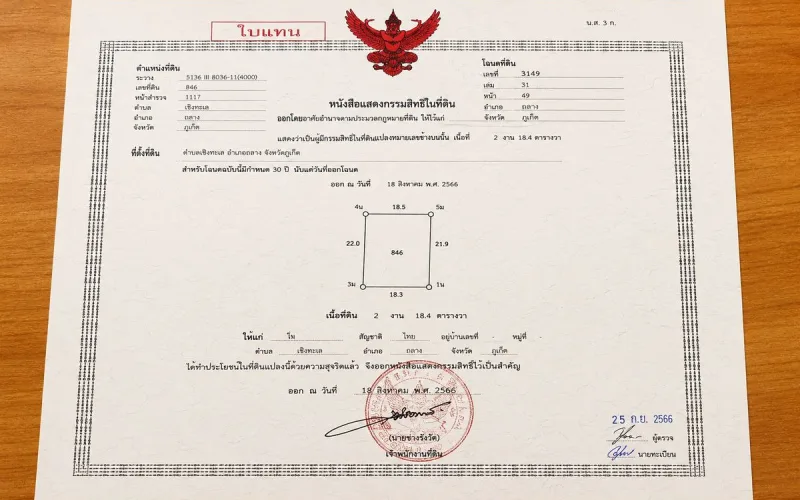
A Chanote, also known as Nor Sor 4 Jor, is Thailand’s key land title deed. For a buyer, it shows who is registered as the landowner, where the land boundaries are located, and which legal actions have been recorded through the Land Department.
This document matters most when buying a villa, a land plot, or any property where land value plays a central role. In deals involving villas in Thailand, a Chanote check helps confirm whether the legal picture matches what the seller presents during the viewing.
What Is a Chanote and Nor Sor 4 Jor?
A Chanote is a land title document. Its official name is often written as Nor Sor 4 Jor. It records the land plot details, the registered owner, boundaries, ownership history, and legal transactions registered with the Land Department.
The main value of a Chanote is precision. The land is surveyed, the boundaries are tied to a coordinate system, and physical boundary markers should be present on the plot. This is why a Chanote is considered the strongest basis for a land transaction in Thailand.
The document is often recognized by the red Garuda mark at the top. This visual feature helps distinguish a Chanote from weaker land documents, although appearance alone never replaces an official title search.
What Rights Does a Chanote Give to the Landowner?
A Chanote confirms registered rights over a specific land plot. The owner can sell the land, transfer it by inheritance, use it as collateral, register long-term agreements, and complete other legal actions through the Land Department.
For a buyer, this creates a clearer transaction. There is a document, a registered owner, defined boundaries, and a history of legal entries. When the deed, registry data, and physical land match, the risk of a land dispute becomes lower.
A Chanote still requires legal due diligence. The deed may include entries related to a mortgage, lien, court dispute, servitude, lease, or another restriction. The title name matters, yet the latest registry check and transaction history matter just as much.
Chanote vs Nor Sor 3 Gor, Nor Sor 3, and Por Tor 5
Thailand has several types of land documents. They offer different levels of legal protection, so the title type can affect price, liquidity, and transaction safety.
| Document type | Meaning | Buyer risk |
| Chanote / Nor Sor 4 Jor | The strongest land title with defined boundaries and Land Department registration. | Main risks relate to encumbrances, seller identity, boundaries, and deed authenticity. |
| Nor Sor 3 Gor | A higher-level land document that may be connected with possession rights and future title upgrade. | The buyer should verify upgrade potential, boundaries, and title history. |
| Nor Sor 3 | A weaker land document where boundaries often need extra verification. | Boundary, access, and neighboring rights risks can be higher. |
| Por Tor 5 | A tax or use-related document connected with land occupation. | This type requires a very cautious legal review for foreign buyers. |
If a seller says the land is “almost Chanote”, request the documents and check the plot status before paying a deposit. A phrase in a chat, brochure, or sales presentation does not replace a Land Department record.
Why a Chanote Matters When Buying a Villa, Land, or Development Plot
When buying a condominium, the core asset is a unit in a registered building. When buying a villa or land plot, the focus shifts to land ownership, boundaries, access, permitted use, and the rights of the registered owner.
If the land has a Chanote, the buyer can more clearly verify the area, boundaries, ownership history, and restrictions. This is especially important for villas, gated communities, building plots, and properties with private road access.
For buyers of condos in Thailand, Chanote may still appear in project documents because the land under the building has its own title. The buyer’s apartment rights are confirmed through a separate unit registration, quota status, and transfer documents.
How to Check a Chanote Before Buying Property
A Chanote check should happen before paying a deposit or signing a contract with strict penalties. A proper review covers the deed, land plot, seller, and fresh Land Department data.
- Verify the owner. The seller’s name or company details should match the registry record.
- Check the title number. A lawyer or representative can use the deed number to request information from the Land Department.
- Review the boundaries. The deed map, boundary markers, and actual land use should match.
- Look for encumbrances. Mortgage, lien, lease, servitude, court entries, and restrictions should be reviewed.
- Check access. Road access, right of way, and utility connections can be as important as the land title itself.
- Review transaction history. Recent transfers, disputes, or unusual entries require extra legal attention.
A buyer should request a copy of the Chanote together with a fresh title check from the Land Department. If the seller refuses to share documents before deposit, it is a strong reason to pause negotiations.
What Foreign Buyers Should Know: Land, Leasehold, Company Structures, and Condominiums
Direct land ownership in Thailand is generally restricted for foreigners. This is why villa and land deals often involve a long-term land lease, a Thai company structure, or another legal setup that should be reviewed by an independent lawyer.
Two questions should be separated: the quality of the land title and the ownership structure available to the foreign buyer. A Chanote can be a strong land document, while the buyer still needs a suitable legal model for the transaction, taxes, and future resale.
To understand the difference between ownership and long-term use rights, start with freehold and leasehold in Thailand. This keeps land title, ownership structure, and foreign buyer rights in separate boxes.
Condominiums follow a different route. A foreign buyer can own a unit within the foreign quota of the project if payment, registration, and transfer documents meet the legal requirements. After registration, use this next-step guide: what to do after buying property in Thailand.
Red Flags: When a Title Needs Extra Attention
Even a strong title deserves careful review. Risk increases when the seller pushes for a quick deposit, shows only a photo of the deed, avoids a Land Department check, or promises to “fix” the land status after payment.
Extra attention is needed for plots near the sea, on hillsides, close to national parks, near roads, canals, and protected zones. In these locations, boundaries, access, permits, and restrictions can change the real value of the property.
Before signing, get document copies, check the title through the Land Department, verify the boundaries on site, and show the contract to an independent lawyer. For a high-value property, this review costs far less than a land mistake that later becomes hard to sell or register on clear terms.